Utagawa Yoshitora, The Battle of Mikatagahara (元亀三年十二月味方ヶ原戦争之図, 1874), Hamamatsu City Museum, Hamamatsu City Cultural Heritage Digital Archive, CC BY 4.0 (cropped)
Mikatagahara三方ヶ原の戦い · The Battle of Mikatagahara
Watch this chapter (12:53)In the autumn of 1572 Shingen led twenty-five to thirty thousand men out of Kai into Ieyasu's province of Tōtōmi 遠江国. For centuries the story was that he was really heading for Kyoto to take on Oda Nobunaga 織田信長, Ieyasu's ally, and that Ieyasu just happened to be in the way. Many historians now read it differently. That autumn Shingen wrote that he was crossing the Tenryū River and marching on Hamamatsu to settle three years of grievances. Where he meant to go after that is still argued over.
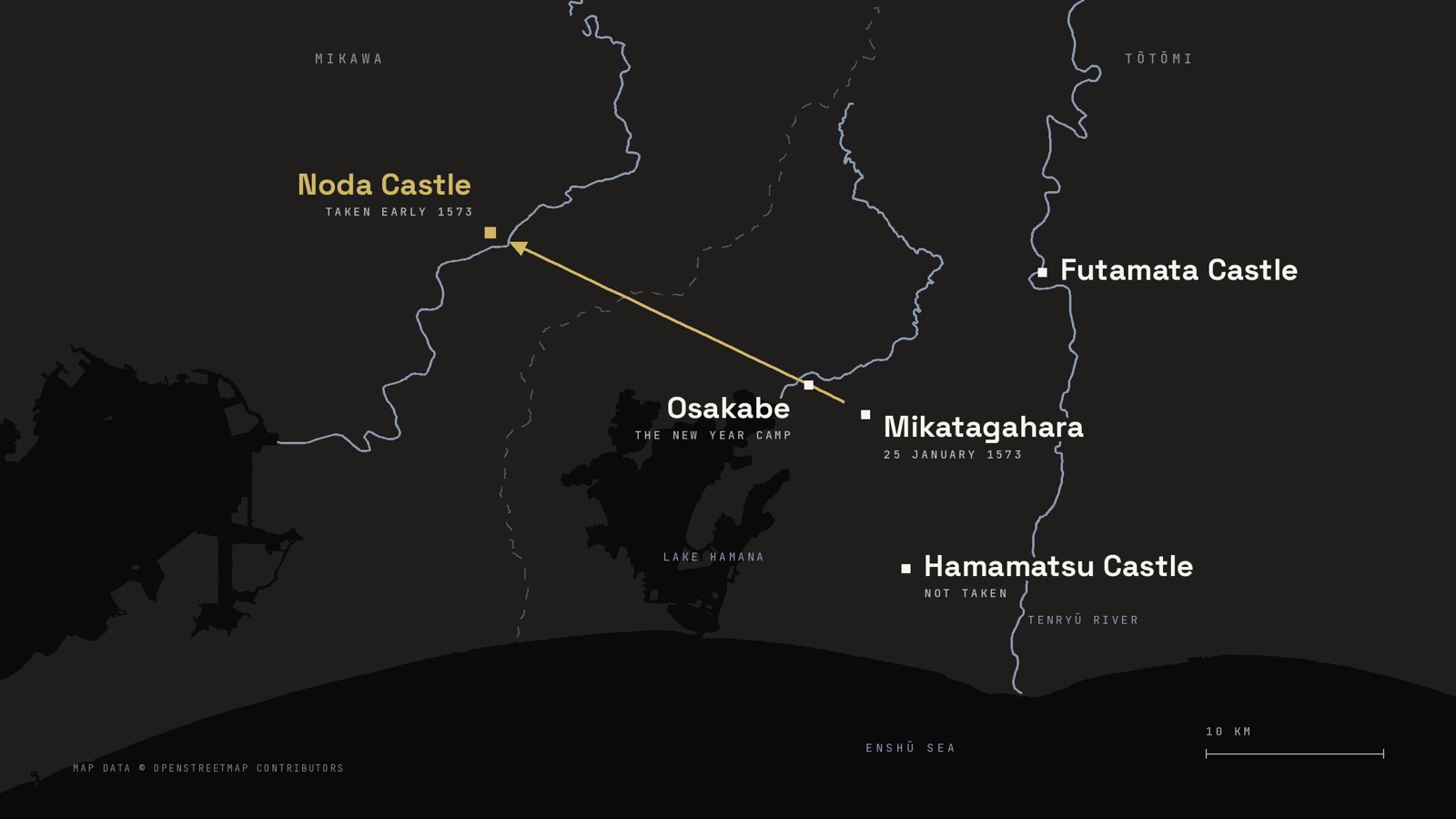
The Takeda clashed with a Tokugawa force on Hitokoto Slope, while Yamagata's column came in through Mikawa. Futamata Castle, the Tokugawa stronghold on the Tenryū, held out for weeks, until the Takeda floated rafts down the river to cut the ropes the garrison used to haul up its water. That left Ieyasu at Hamamatsu with about eight thousand men of his own and around three thousand sent by Nobunaga.

The Invasion
Out of Kai into Tōtōmi. Hitokoto Slope, then the siege of Futamata.
Mikatagahara 三方ヶ原の戦い
About 11,000 Tokugawa and Oda men against 25,000 to 30,000 Takeda, from late afternoon to nightfall.
Saigagake
Ōkubo Tadayo's arquebusiers fire into the Takeda camp.
The Tiger Dies
Of illness, on the road home, after taking Noda Castle.
Then Shingen marched straight past Hamamatsu Castle, heading west across the Mikatagahara plateau. Later accounts say Ieyasu's senior retainers, and Nobunaga's officers too, begged him to stay behind his walls. In a memoir by the Tokugawa retainer Ōkubo Tadataka, Ieyasu answers that no man stays indoors while an enemy marches across his back yard, and that whether you win is up to heaven, whatever the numbers. One of the more reliable early chronicles has no council at all: in that version Ieyasu rides out to pull back his scouts and gets dragged into a battle he never planned.
The Takeda turned to meet him at the top of the slope at Hōda. Ōkubo's memoir says Shingen formed up in the fish scale, a deep wedge of units that could relieve one another, while Ieyasu stretched his smaller army wide and thin in the crane's wing. The battle began late in the afternoon, when Shingen sent out a few hundred stone-throwers and the Tokugawa charged. In that first clash the Oda commander Hirate Hirohide was killed, and years later Nobunaga would accuse another of his generals, Sakuma Nobumori, of leaving Hirate to die. For a while the Tokugawa broke the first Takeda lines, and Ieyasu's own guard drove Yamagata's unit back. Then Shingen fed in fresh units, his son Katsuyori hit the Tokugawa in the flank, and their line gave way. By nightfall about a thousand Tokugawa men were dead, many of them senior retainers.
Ieyasu got back to Hamamatsu with only a handful of men. English books often say five. I couldn't find that number in any Japanese source.
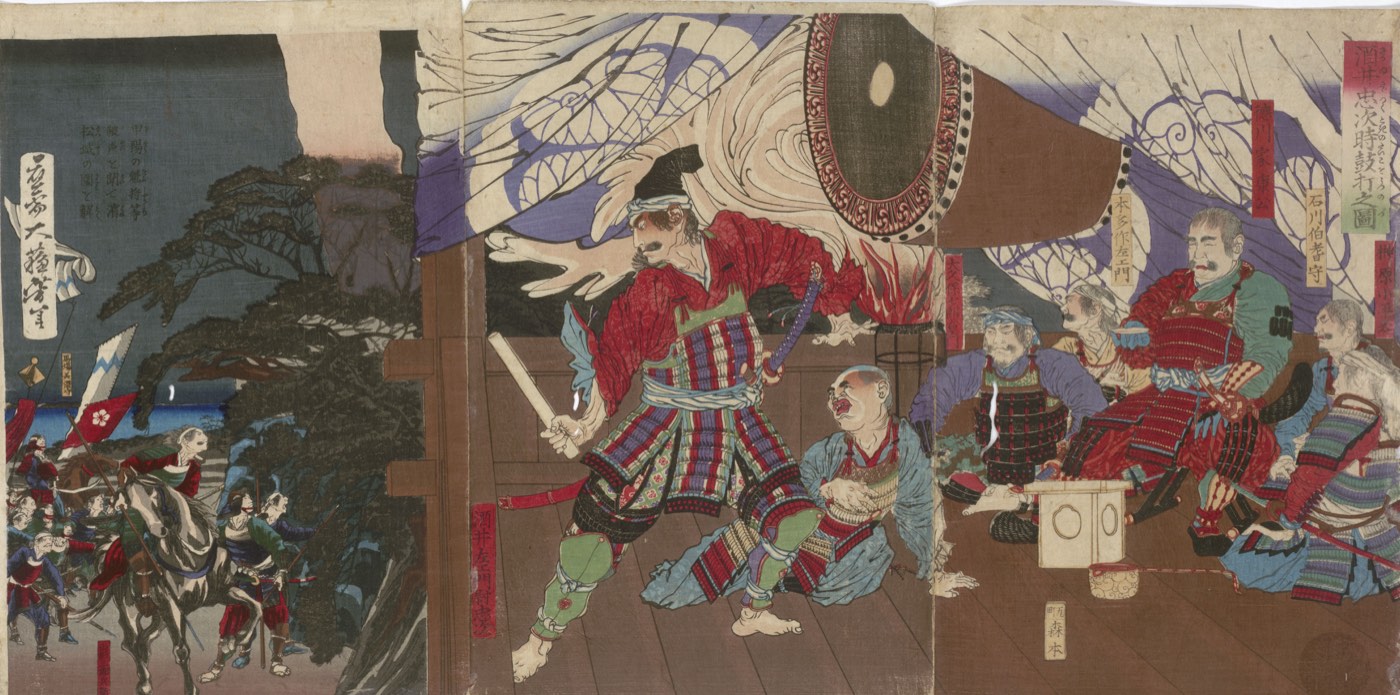
What happened next is one of the best-known stories in Japanese history, and most of it is legend. Tokugawa tradition says Ieyasu ordered the gates left open and fires lit outside, so stragglers could find their way in, and that when Baba and Yamagata reached the castle at dusk, Yamagata wanted to storm it and Baba smelled a trap. The version you'll hear most often adds Sakai Tadatsugu beating a great war drum on the gate tower, which comes from a kabuki play first staged in Tokyo in 1873. The Takeda's own chronicle tells it the other way round. The day after the battle, Baba, Yamagata, Naitō and the other senior generals urged Shingen to attack Hamamatsu, and Kōsaka argued against it, warning that a siege would take weeks and give Nobunaga time to send help. Shingen listened to him.
That night the Tokugawa hit back. According to Ōkubo Tadataka, his elder brother Ōkubo Tadayo gathered about a hundred arquebusiers and fired into the Takeda camp at Saigagake, a ravine just north of the castle. Local legend adds Takeda soldiers falling into the gorge in the dark over a fake bridge made of cloth. The ravine is still there, with a small museum on its edge. In Nioh 3, Saigagake is where Takechiyo makes a strike before dawn on Ieyasu's orders and fights Shingen's yokai form.
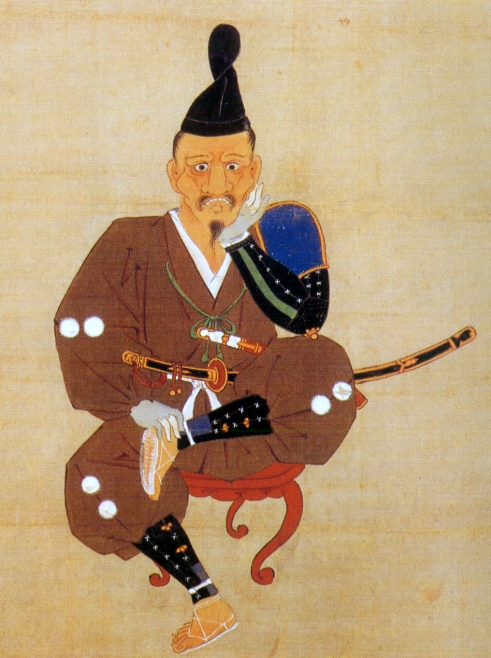
That story turns out to be young. The museum's own curator, Hara Fumihiko, traced the painting's history. It came into the Owari branch of the Tokugawa family in the late 1700s, and an inventory of 1880 calls it a portrait from the Battle of Nagashino. The first link to Mikatagahara appears in newspapers in January 1936, just after the museum opened, and the line about keeping it by his side first appears in the museum's own catalogue in 1972. The museum now dates the painting to the seventeenth century and says there's no evidence for the Mikatagahara story, and Hara even raises the possibility that it was never meant to be Ieyasu. His real record makes the point without the painting: he outlived Shingen, Nobunaga and Hideyoshi, and in 1615 he finished off the Toyotomi at Osaka.
Shingen never took Hamamatsu. He spent the New Year nearby at Osakabe, then pushed west into Mikawa and took Noda Castle in early 1573, again by cutting off its water. By then he was seriously ill.
The real Shingen turned for home and died on the road in Shinano in May 1573, at fifty-one. The chronicle says a doctor had diagnosed him years before with an illness it calls kaku, in which food won't stay down, and the usual modern guesses are stomach cancer or tuberculosis. A rumour was already going round that he'd been shot by a sniper at Noda Castle, and the same chronicle calls that a lie. His will, it says, ordered his death kept secret for three years, and the Takeda did hide it, holding his funeral only in 1576.
His son Katsuyori 勝頼 took over. At Nagashino 長篠 in 1575, Katsuyori attacked an Oda and Tokugawa army dug in behind wooden palisades. The Kōyō Gunkan says his senior generals, Baba, Naitō and Yamagata among them, urged him not to fight, and that he overruled them. Attack after attack broke against the guns behind the fences, and Yamagata, Baba and Naitō were all killed that day. The chronicle says Baba, still without a wound, held his ground until Katsuyori's banner was out of sight, then turned, called out his own name, and was speared without drawing his sword. Kōsaka wasn't there. He was guarding the frontier with the Uesugi, and he died of illness three years later. The Takeda house never recovered, and it was destroyed in 1582.