I traced the lion dance through my Phantom Blade Zero films, from a Buddhist procession in Luoyang around 547 to the Shenzhen masters S-GAME learned its lion boss from.
The oldest description of lions in a Chinese procession comes from Luoyang around 547. The lions lead a statue of the Buddha through the streets, with sword-swallowers and fire-breathers beside them.
It is in Yang Xuanzhi's record of the Buddhist temples of Luoyang. The statue went out on the fourth day of the fourth month, and the fire belongs to the performers the text lists beside the lions.
1 source
楊衒之《洛陽伽藍記》卷一 (Wikisource, 四庫全書 edition) · 13 Nov 2026ZH · “辟邪師子導引其前吞刀吐火”(bixie beasts and lions lead the way before it, with blade-swallowing and fire-spitting)
02Two rites: waking the lion and plucking the greens
Two customs of the southern lion that turn up in the game: the brushstroke that wakes a new lion, and the lettuce it dances for.
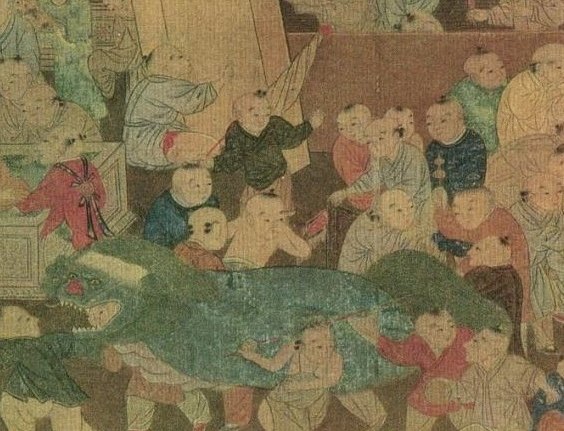
Plate IChildren dancing a lion: a detail of One Hundred Children Playing in Spring, 百子嬉春圖, attributed to the Song painter Su Hanchen, 12th century.Su Hanchen (attrib.), Song · Public domain
Before a new lion dances for the first time, an elder dots its eyes with a brush dipped in red cinnabar, and the lion comes alive. Chinese calls it 点睛, dotting the eyes.
The government of Suixi county in Guangdong describes the elder using cinnabar or gold powder, then stroking the lion's head.
Once Upon a Time in China III, the third of Tsui Hark's Wong Fei-hung films, is built around a lion dance contest. Liang has said it may be his favourite of the series.
Liang says the lion dance masters told him the fighting lion came before the films. Troupes travelling from town to town were robbed by bandits on the road, so they hid blades inside the lion and used its head as a blade and a shield.
When rival lion dance schools challenged each other, the masters told him, the fights were real.
Every motion capture for the lion boss was done by senior lion dance masters, Liang says, because a Chinese team should show the real essence of the dance.
He set it against Elden Ring's lion dance boss, which he called more of a fantasy.
In Xinhua's documentary a lion dance coach teaches S-GAME's team that the dance is about spirit, expression and every single step. Slower, slower still, he tells them, as if you were sneaking home.
S-GAME's own kung fu team takes what Donnie Yen, the lion dancers and the sword masters bring and turns it into game moves. Liang calls them translators.
IGN's reviewer wrote that at one point he was wearing a lion dancer mask, jumping around on poles to collect heads of lettuce to power up his fire blast.
In the English State of Play the lion dance boss shouts an order to his disciples in Cantonese, under the subtitle “Diciples, hear me! Return to your posts!” The game has no Cantonese voice track.
The language is my ear's call, and the subtitle's spelling is S-GAME's. Steam lists full audio in English and Simplified Chinese only.
For the fight's first phase the music team recorded the lion dance troupe on site, Liang says, and in the second phase the music switches straight to hard electronic.
Every fact on the culture pages carries one of these. The fourth is for what I read off my own save. English in brackets after a Chinese quote is my own rendering.
ConfirmedS-GAME's own words, or a reference I opened and quote: the original text, a dictionary, an encyclopedia, a study or a news report.
ReportedSomeone else says it: a Chinese player, an uploader, a guide or a critic, named every time.
TheoryMy own reading of the material, labelled as mine and never presented as fact.
My saveRead off my own PS5 Pro save: the game's text, its voice lines and what happens in a fight, dated, with a link to the moment in the film.