I checked every weapon S-GAME showed before launch against China's dynastic histories, its old army manuals and its museums, to see which ones are real.
Sometimes, the same post says, S-GAME has master swordsmiths forge a real copy of a weapon, to learn how its weight and length change the way it moves.
02Ancient tradition: swords, sabres and the army's arsenal
The oldest of Liang's three sources. These are real weapons of Chinese armies, read in the dynastic histories and the Song and Ming army manuals. Where I tie one to a weapon in the game, I say the match is mine.
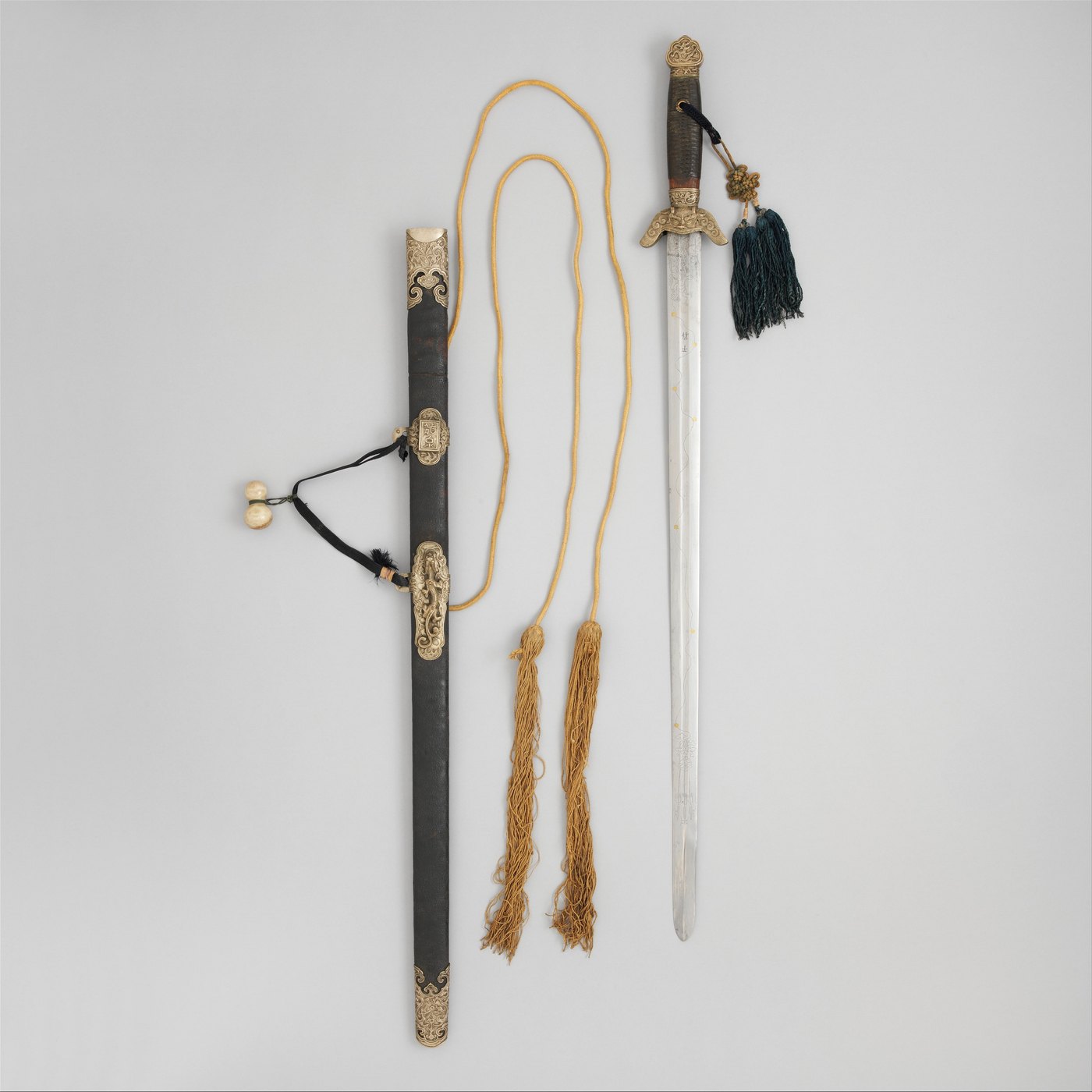
Plate IA jian with its scabbard, Chinese, 18th to 19th centuryThe Met · CC0
China's list of blades starts with two words: 剑, jian, the straight sword with two edges and a point, and 刀, dao, with one edge, the sabre.
Around the year 200 the dictionary 釋名 defined them by what they are for. The sabre chops; the sword guards you against the unexpected and tucks inside your arm when you bow.
The horse-cutting sword is real: in the Han dynasty the official Zhu Yun asked his emperor for the palace workshop's horse-cutting sword, to behead one flattering minister as a warning to the rest.
A later scholar, Yan Shigu, explained the name: the blade was sharp enough to cut a horse. In 1072 a Song emperor showed the general Cai Ting a horse-cutting sabre in a box. Cai said it was well made and easy to swing, so the court had tens of thousands made for the frontier.
宋史, 卷一百九十七, 兵志十一, on Chinese Wikisource · 13 Nov 2026ZH · “乃命中人領工造數萬口賜邊臣”(so he had a palace official oversee tens of thousands made for the frontier commanders)
By the Ming dynasty the two-handed sabre had new teachers: a manual of 1621 says its art came from the Japanese pirates, and that it leaps about so unpredictably that longer weapons often lose to it.
General Qi Jiguang drilled his musketeers with a long sabre in the same Japanese way: a low cut at a post standing for a horse's leg, then a turn and an upward cut at one standing for its head.
Quelling the Bandits, 蕩寇志, is a real novel, usually dated 1853, written to finish off the Water Margin: in it every one of the outlaw heroes is killed or executed.
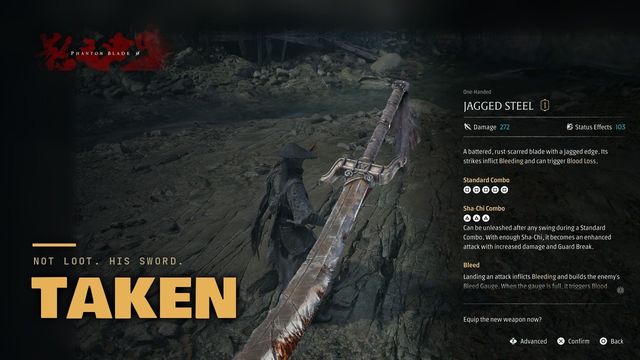
The 2025 demo had a two-handed army blade, the Juggernaut, and its Chinese name there was probably 荡寇凶刃, the bandit-crushing fierce blade. That match is mine. Liang has said the army blades remind him of the Water Margin.
China had a crouching tiger cannon, 虎蹲砲. General Qi Jiguang wrote it up around 1571 and said it is named for its shape.
It was wrought iron, about two feet long, staked down with iron claws and loaded with up to a hundred small balls and a stone on top. Ming troops fired it in Korea against the Japanese invasion of the 1590s. The name is older than the gun: in the Song army's manual of 1044 a 虎蹲砲 is a trebuchet. The game's Tiger Cannon is 虎炮 in Chinese, and tying it to Qi Jiguang's gun is my match.
By the Ming the head was gilded and shaped like a melon, and the war club had become palace regalia: some guards at court held golden melons, 金瓜, and some held iron ones.
The History of Yuan, finished in 1370, already describes melon heads coated with gold on the court's staffs.
3 sources
大明會典, 卷一百十七, on Chinese Wikisource · 13 Nov 2026ZH · “明盔甲懸金牌佩刀執金瓜”(in bright armour, with gold tablets and sabres, holding golden melons)
大明會典, 卷一百十七, on Chinese Wikisource · 13 Nov 2026ZH · “八人紅盔青甲懸金牌佩刀執鐡瓜”(eight in red helmets and dark armour, with gold tablets and sabres, holding iron melons)
In 1425 the Hongxi Emperor, furious at an official's memorial, ordered his guards to beat the man with golden melons. Three of his ribs broke and he was dragged out nearly dead.
The official was Li Shimian, and he lived. The story is in the official History of the Ming.
The costume-drama phrase about smashing a skull with a golden melon comes from a novel, Investiture of the Gods, set more than two thousand years before anyone carried one.
In chapter 17 the last Shang king orders palace women beaten to death with golden melons, and his consort Daji talks of 擊頂, striking the crown of the head.
04Martial folklore: real things that were never weapons
Liang's second source. A lion's head, a fire engine, a lute and a bell are all real things, and none was made to fight with. The fire weapon beside them is real, and so are the drunken and soft swords, though their history as weapons is thin.
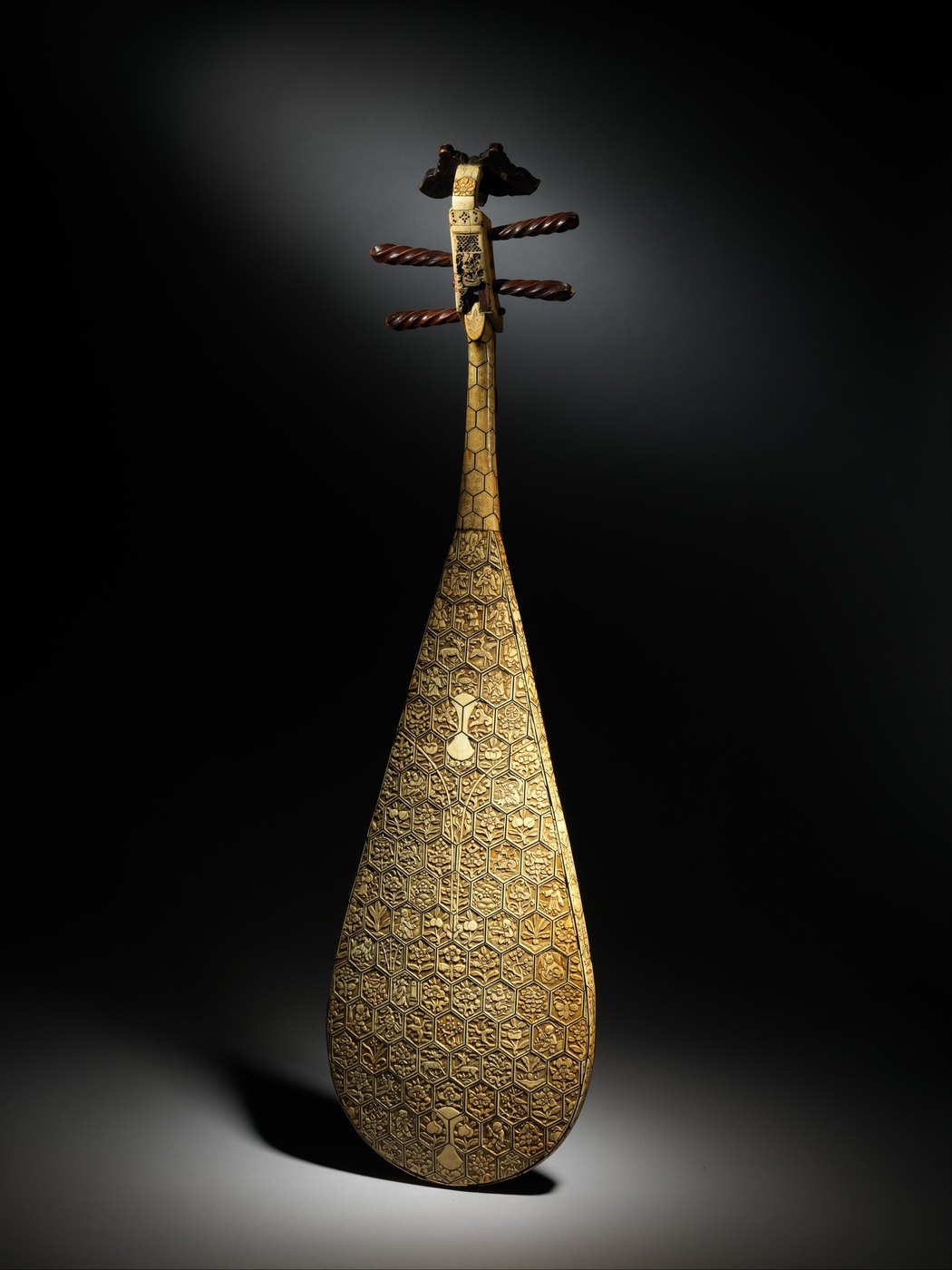
Plate IIA pipa, Ming dynasty, late 16th to early 17th centuryThe Met · CC0
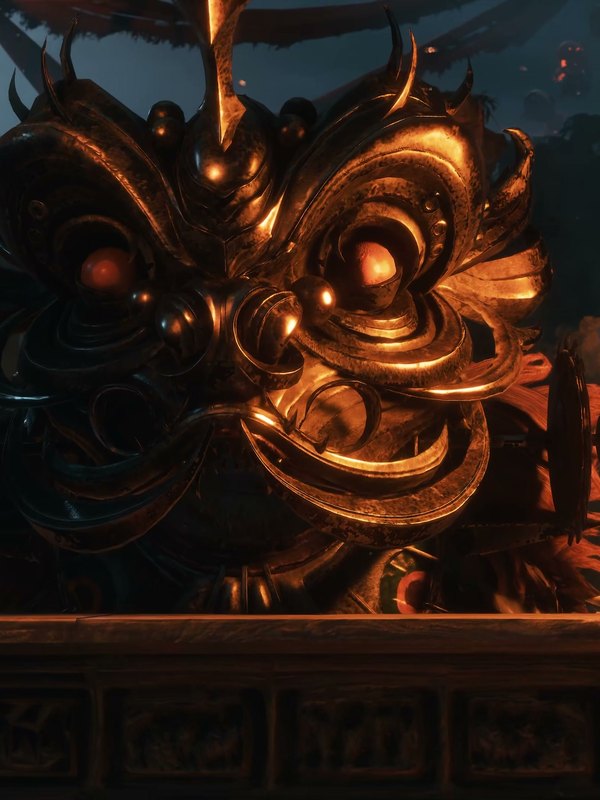
The Flaming Mane is a lion dance head that breathes fire, and the head itself began as a dance costume.
The film rates it a real thing that was never made as a weapon. The lion dance topic has the head's history, from the carved wooden lion Bai Juyi described around 809, and the masters' story of troupes hiding blades inside the lion against bandits on the road.
China had a real fire weapon: the Song army's manual of 1044 describes a brass tank on four legs with a pump that forced fierce-fire oil out through a lit muzzle as flame.
Men caught in it were burnt to a pulp, the manual says, and it gives one warning about oil fires: never use water, because water only makes them fiercer.
China's old hand-pumped fire engines were called water dragons, 水龍. In the 1850s the city of Tianjin had forty-eight of them, with two hundred local men to each, and the men drilled in martial arts.
The game's weapon grid has a dragon's head among its unnamed icons. Tying it to the water dragon is my reading.
The pipa is real and old: a dictionary from around the year 200 says it came from Central Asia, where it was played on horseback, and that its name copies the playing.
Pi is the hand pushing forward and pa the hand pulling back. The dictionary's word is 胡, the peoples to the north and west of China; Central Asia is my gloss.
As a weapon, the pipa lives only in stories. In the Ming novel Investiture of the Gods, the general Mo Lihai's pipa has four strings for earth, water, fire and wind, and plucking them brings wind and fire.
The novel makes him and his brothers the Four Heavenly Kings who guard Chinese Buddhist temples, and in those temples the King of the East still holds a pipa, as the Ming statue at Shanhua Temple in Datong does.
Drunken boxing and the drunken sword are real styles, but younger than they look: the oldest drunken-boxing text, a song about the Eight Drunken Immortals, was not printed until 1929.
It is said to come from a commentary of 1784, but Wikisource's editors note there is no proof of that date. The song gives the drunk immortal Lü Dongbin a pair of flying swords on his back. In the game, the Fanatic's Broken Blade only flies once Soul has had a drink.
2 sources
拳經拳法備要, 醉八仙歌, on Chinese Wikisource · 13 Nov 2026ZH · “呂洞賓,酒醉仙。背上兒,雙飛劍”(Lü Dongbin, the drunken immortal; on his back, a pair of flying swords)
The closest thing to a soft sword in Chinese history is a curiosity: around 1088 the scholar Shen Kuo wrote about a general's sword that could be bent into a box and sprang back straight, and filed it under strange matters.
I found no sword you can coil in any army manual or among the old pieces in the museums I checked. Today the soft sword is a show weapon.
The flying guillotine, 血滴子, is a legend. The tale of the Yongzheng Emperor's agents dropping a bladed cage over a man's head and pulling it back with the head inside first appears in print in the 1910s, nearly two centuries after his reign.
It turns up in anti-Qing histories and novels written after the dynasty fell, and one of them, 清史演義 of 1916, says it is going on old folks' tales. Nobody has found one or produced a Qing record of one. Liang himself describes it as a weapon that legends say Qing emperors used against their enemies.
China's most famous thrown ring is in Journey to the West, from 1592: the sage Laozi takes a ring off his arm, drops it from heaven and hits the Monkey King on the head.
As a real weapon, the only thrown ring I could find is India's chakram, like the Sikh quoit at the Met. The game's Seamless Death is a pair of bladed rings you throw.
2 sources
西遊記, 第六回, on Chinese Wikisource · 13 Nov 2026ZH · “天上墜下這兵器,打中了天靈”(the weapon fell from heaven and struck him on the crown of the head)
Flying knives that never miss come from the novels: in the Water Margin the hero Xiang Chong carries twenty-four flying knives stuck in his shield, and in Gu Long's novels Little Li's flying knife never misses.
S-GAME's card for the game's Flying Daggers says they never miss their mark.
Guan Yu's crescent blade belongs to the novel. The official history of the Three Kingdoms says he rode into ten thousand men and stabbed his man, and the crescent blade is first drawn in the Song manual of 1044, about eight hundred years after he died.
The Green Dragon Crescent Blade is the weapon Romance of the Three Kingdoms gives him. Chinese press described the big crescent blade Soul swings in the pre-order trailer as a divine weapon shaped like it.
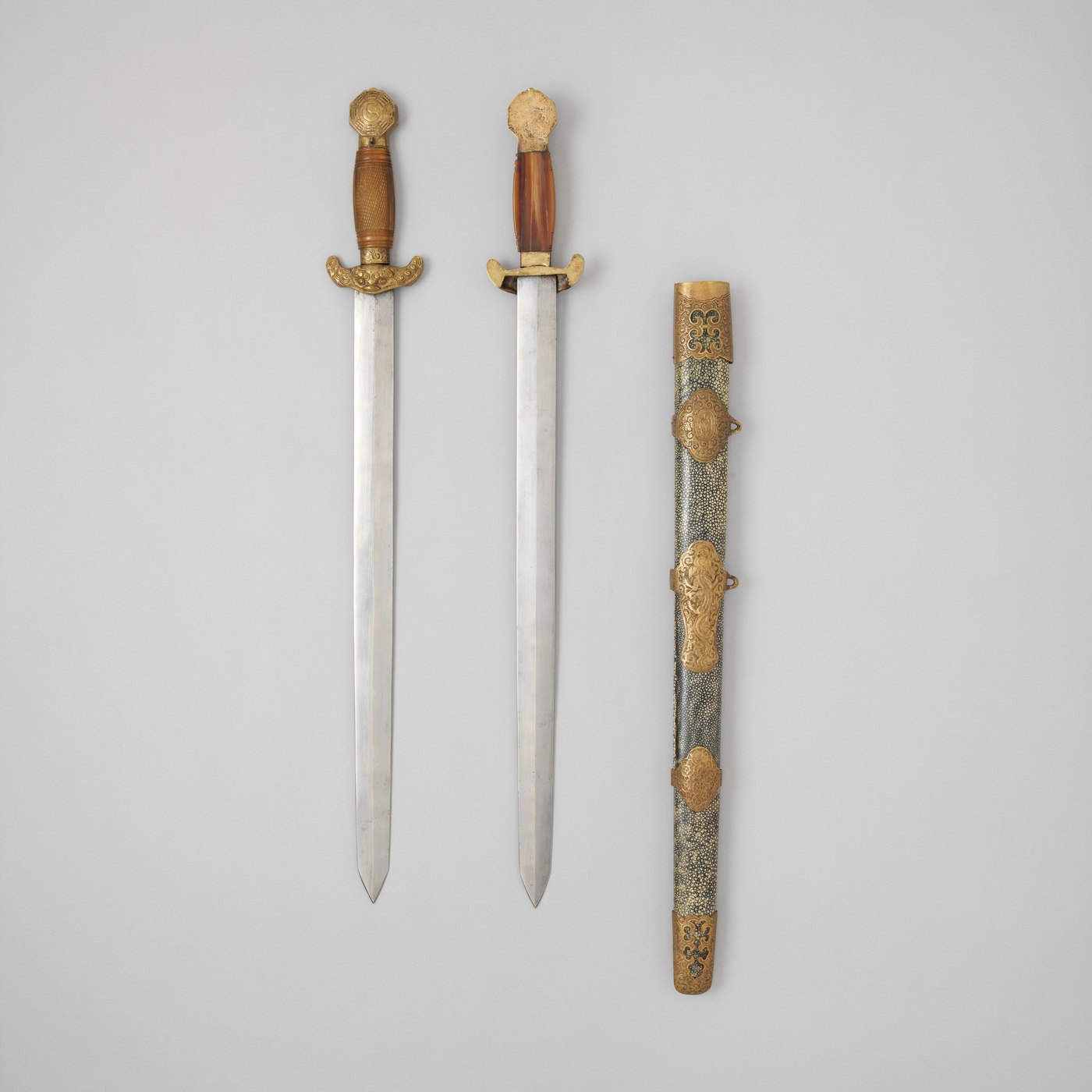
Twin swords are real Chinese history: the Met holds a pair of Chinese swords that share one scabbard, and a fifth-century poem has twin swords crying out in their case before they part.
In Bao Zhao's poem the female sword sinks into a river and the male flies away.
The clearest case is the Armybreaker, a long-shafted blade that looks like the Tang army's 陌刀. Liang says it is a fantasy weapon of S-GAME's own design, drawn from the way old armies fought in formation.
S-GAME's card calls it a broad-bladed polearm built to break enemy formations. It is so heavy that Soul kicks it up to get it swinging.
The real Tang long blade, the 陌刀, is a mystery of its own: a Tang army manual of 759 issues one to every fifth soldier, and armies carried them by the thousand, yet not one has ever been dug up.
In 757, outside Chang'an, the general Li Siye stripped to the waist, took a long blade and stood roaring in front of his line, and the Old Book of Tang says that where his blade landed, horse and rider were smashed together.
The Song army's manual of 1044 says its fiercest fighters liked to have their own blades made in unusual designs, just to stand out, with names like Mountain-Opener, Formation-Opener and Formation-Cleaver.
The game's own weapon cards and S-GAME's own pictures, and the matches I make between them and the history above. Where a match is mine, it carries the theory label.
I read the Outlaw's Warblade as the horse-cutting sabre. Its Chinese name isn't on any official footage I found, but one Chinese review praises a two-handed blade that breaks shields and drinks life and calls it 亡命斩马刀, the outlaw's horse-cutting sabre.
S-GAME's card calls the Outlaw's Warblade a ruthless, blood-drinking warblade that breaks shields. The match rests on what the two blades do.
S-GAME's card calls the Heartrend Pipa a replica pipa with a clear, mournful tone that rends the heart, and says its music releases sonic blades sharp enough to cut through anything.
Liang's own reference for the pipa is a wuxia novel. In a 2025 interview he said Western press already find a soft sword strange, and his Six-Fingered Qin Demon stranger still: his pipa plays sound waves.
The Six-Fingered Qin Demon, 六指琴魔, is a wuxia novel by Ni Kuang about a killer whose weapon is music. Liang's words are from my own transcript of the video.
The Soft Snake Sword is personal: Liang told Inverse it is from his own office, and he had a kung fu master take the soft sword from his collection to the studio to record every sound it makes.
That meant more than the swings: cutting paper, and cutting meat.
I read a photo in S-GAME's April post as one of the forged replicas: a real pair of White Serpent and Crimson Viper swords, still on bubble wrap, the long one with a scroll guard and the short one with a snake coiled round its grip.
S-GAME didn't caption the photo, but it is a real object made for this game. In the game the two blades work as a pair, the long one flinging the short one.
Every fact on the culture pages carries one of these. The fourth is for what I read off my own save. English in brackets after a Chinese quote is my own rendering.
ConfirmedS-GAME's own words, or a reference I opened and quote: the original text, a dictionary, an encyclopedia, a study or a news report.
ReportedSomeone else says it: a Chinese player, an uploader, a guide or a critic, named every time.
TheoryMy own reading of the material, labelled as mine and never presented as fact.
My saveRead off my own PS5 Pro save: the game's text, its voice lines and what happens in a fight, dated, with a link to the moment in the film.