I went back through what my films say about wuxia, from a complaint about the xia written more than two thousand years ago to the brush calligraphy on the launch trailer's last card, and traced every line to its source.
The genre's name has two halves, 武, martial, and 侠, the fighter with a code of his own. These are the oldest texts my films quote on the 侠, where the word itself came from, and the director's own line on it.
More than two thousand years ago the philosopher Han Fei counted the 侠 among the vermin of the state. Scholars throw the law into disorder with their learning, he wrote, and the 侠 break its bans by force.
The line is in chapter 49 of the Han Feizi, The Five Vermin. The English here is my gloss; James J. Y. Liu's published translation has the knights-errant violating the prohibitions by force.
About a century later the historian Sima Qian gave the wandering 侠 a chapter of their own in the Shiji. They don't always keep to what is right, he grants, and yet their word is kept and what they start they finish.
It is chapter 124, 游侠列传, the biographies of the wandering knights. He goes on that they honour their promises, throw themselves into other people's danger without sparing their own lives, and never boast of it. The English is my gloss.
The word 武侠 itself is young. It came into Chinese at the end of the Qing dynasty, early in the twentieth century, borrowed from the Japanese bukyō, a label for adventure stories.
Before that the old words for these fighters were 游侠, wandering knights, and 剑侠, sword knights.
Liang splits wuxia into two layers and says the second matters more: 武 is what shows on the outside, the action, and 侠 is what's inside.
He said it on camera for Xinhua's documentary of February 2026, in the words 武是外显,侠是内在. S-GAME used the same take in its own video, What exactly is Wuxia?, with English subtitles.
Liang says the genre now feels old at home and abroad, its golden age long gone, and S-GAME tells the foreign press it wants to rediscover wuxia and redefine it.
Some of that press likened the studio to Bruce Lee taking kung fu to Hollywood. His hope is a kind of action game you can name as readily as the kung fu movie, where you know how it fights, how it is staged and who is in it.
江湖, rivers and lakes, is an image from the Daoist classic Zhuangzi: two fish stranded in a drying spring keep each other wet with their spit, when they would be better off forgetting each other in the rivers and lakes.
The passage is in the chapter 大宗師. In wuxia the word came to mean the world beyond the law: roads, inns, temples, bandit hideouts.
Liang says the game's own jianghu lives in its side quests: strangers meet by chance, you learn someone's secret, settle it in passing and go back to your own road.
S-GAME's video What exactly is Wuxia? says the same of its side quests, where you are a passerby in other people's stories.
In a 2023 interview Liang said the core of wuxia is a rough, common feel, the loves and hates of every walk of life. His team was used to making things pretty, and he asked for it broken, grimy and travel-worn.
In the same answer he calls the jianghu the world of common people, apart from the court.
Liang uses the word for his own trade. Writing just after Zero was revealed, he listed his lowest moments, among them giving up the name Rainblood and watching Mirage sell well while the company was about to fold, and wrote that China's games world is a 江湖.
At ChinaJoy 2024, S-GAME's team called the clash of righteous and wicked one of the great themes of Chinese martial arts fiction. They pointed to Jin Yong's The Smiling, Proud Wanderer and The Heaven Sword and Dragon Saber, where the righteous turn out wicked and the wicked righteous.
S-GAME's upload doesn't name the speaker, so I credit the team. The Chinese is my transcription.
In The Smiling, Proud Wanderer the hero, Linghu Chong, is thrown out of the righteous Mount Hua Sect, its respected head turns out to be a villainous hypocrite, and he ends up beside a leading figure of the cult everyone calls demonic.
The sect's head, Yue Buqun, is also the hero's own teacher. The cult is the Sun Moon Holy Cult, often called the Demonic Cult, 魔教.
The launch trailer's Mandarin dub opens on a man praised as a pillar of 正道, the righteous path, and its last line names the 正道联盟, the Righteous Alliance. Where the Mandarin says 正道, S-GAME's English says the Mandate.
The dub has no subtitles, so the Chinese is my transcription.
Jin Yong and Gu Long are the two biggest names of modern wuxia, and they build their heroes in opposite ways. Liang has said which he prefers, and which kind of hero Soul is.
Jin Yong's most famous hero, Guo Jing, starts out slow to learn and grows into the man who defends a city under siege. The books call him the greatest kind of 侠, one who serves his country and his people.
Tsui Hark filmed his story again in 2025, and its Chinese title ends with the same phrase: 射雕英雄传:侠之大者.
3 sources
Wikipedia (Chinese), 郭靖 · 16 Oct 2026ZH · “為國為民,俠之大者”(for the country and the people: the greatest of xia)
Wikipedia, Guo Jing · 16 Oct 2026 · “a slow learner who needs repetition, practice, and patience”
Gu Long's heroes are already the best when you meet them. Little Li of the Flying Dagger never misses and coughs his way through his book with a lung illness, and the swordsman Fu Hongxue is lame and epileptic.
Gu Long wrote in short sentences and short paragraphs, mostly dialogue, and his influences ran from Hemingway and Jack London to James Bond and The Godfather.
3 sources
Wikipedia, Gu Long · 16 Oct 2026 · “His novels are usually made up of short sentences and paragraphs”
Wikipedia, Gu Long · 16 Oct 2026 · “Ernest Hemingway, Jack London, John Steinbeck, and Friedrich Nietzsche”
Liang has picked a side. He told 游戏陀螺 in 2023 that personally he loves Gu Long's wuxia more than Jin Yong's, and that the wuxia world feels lonely and bleak to him, to look at and to read.
Talking about Soul on the podcast, Liang reaches for the Gu Long kind of hero, one who is unbeatable from the moment the story starts. Without growth there can still be an arc, he says, in what changes inside him.
In a 2019 essay Liang wrote that Sekiro really is very wuxia, and that its lonely shinobi is a Japanese version of 孟星魂, the assassin in Gu Long's novel Meteor, Butterfly, Sword.
He hoped someone would one day make a true wuxia game like it, set in Chinese culture.
In Meteor, Butterfly, Sword, 孟星魂 is one of four orphans whom Boss Gao adopts and raises to be her assassins.
The Shaw Brothers filmed the novel in 1976 as Killer Clans, directed by Chor Yuen. In the 1993 version, Butterfly and Sword, Tony Leung plays 孟星魂 and Donnie Yen is in the cast.
4 sources
Wikipedia (Chinese), 流星·蝴蝶·劍 · 16 Oct 2026ZH · “幼年被快活林主人高老大收養”(adopted as a child by Boss Gao, who runs the Kuaihuolin)
Asked on a Chinese podcast in December 2025 which three films shaped the game, Liang named more than three. Here they are with their years and directors, and the rule he takes from them.
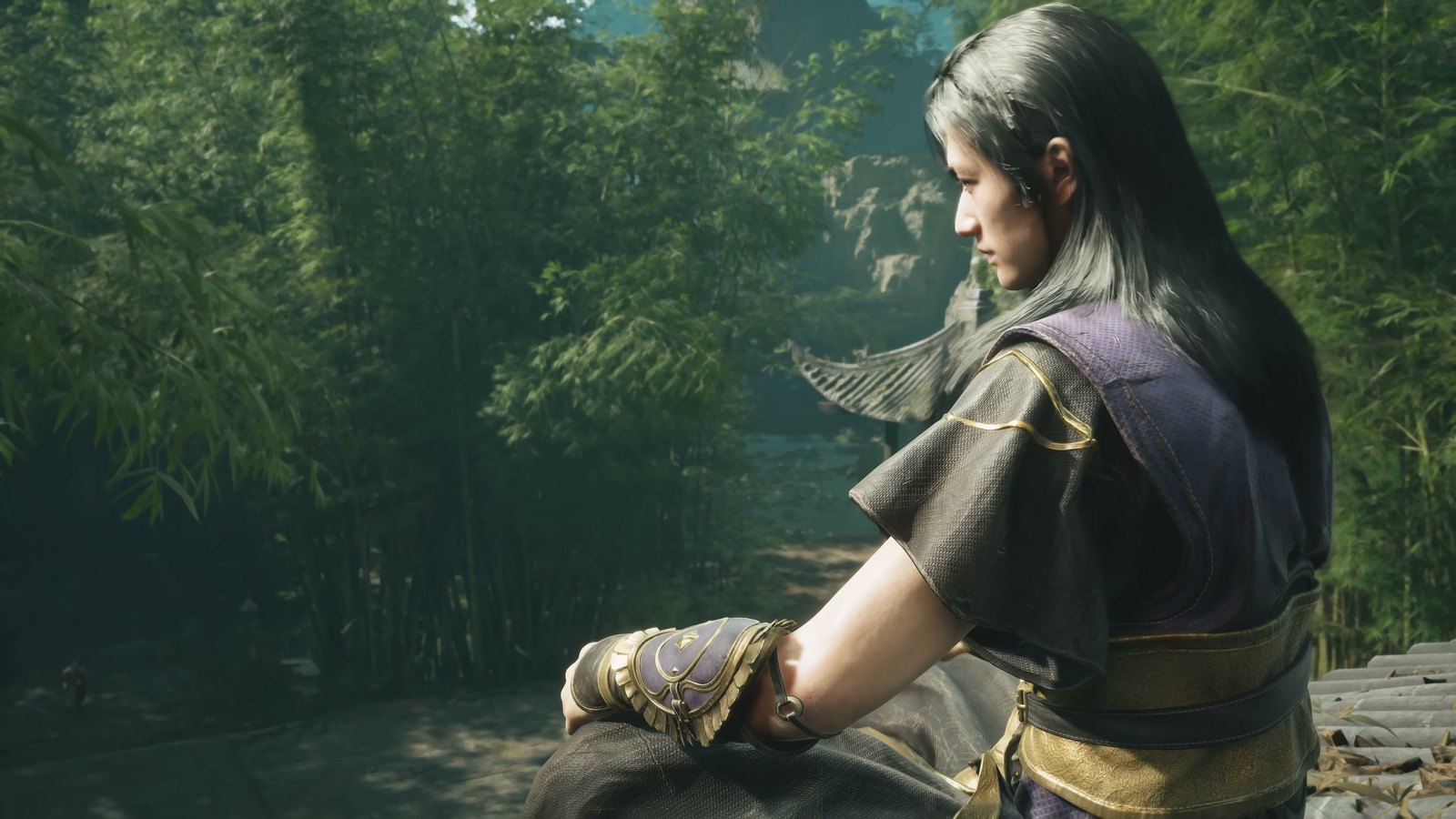
Plate IA swordsman in a bamboo grove. State of Play deep dive, Aug 2026S-GAME · Official media
Most of the films on Liang's list come from two moments. From 1965 the Shaw Brothers studio launched a new style of wuxia film, with King Hu and Chang Cheh among its directors, and in the early 1990s Tsui Hark directed or produced the rest.
His first pick, New Dragon Gate Inn (1992), was directed by Raymond Lee and produced by Tsui Hark. Donnie Yen plays the villain, Cao Shaoqin, a eunuch who runs the Eastern Depot, the Ming emperor's secret police.
The scene that stayed with Liang is its climax, shot with no computer graphics: the inn's cook takes a knife to Cao Shaoqin and strips a hand and a foot to the bone.
New Dragon Gate Inn is itself a remake of King Hu's Dragon Inn (1967), and in 2011 Tsui Hark went back to Dragon Gate again with Flying Swords of Dragon Gate.
A Touch of Zen, by King Hu, came out in two parts in 1970 and 1971 and won the Technical Grand Prize at Cannes in 1975. Liang says it shaped the game's world more than its fights: bamboo forests, reeds, ruined city walls, and two figures in big red robes walking out against a cold background.
The Blade (1995) is Tsui Hark's. Its hero, played by Vincent Zhao, loses his right arm and fights on with his father's broken sword chained to his wrist, which Liang calls pretty punk.
Behind The Blade stands Chang Cheh's One-Armed Swordsman (1967) for the Shaw Brothers, which Liang named in his 2019 essay. It was a record-breaking hit that took more than HK$1 million.
Tsui Hark made The Blade as his homage to it.
4 sources
Wikipedia, One-Armed Swordsman · 16 Oct 2026 · “a 1967 Hong Kong wuxia film produced and distributed by the Shaw Brothers Studio”
Swordsman II (1992), directed by Ching Siu-tung and produced by Tsui Hark, adapts The Smiling, Proud Wanderer, with Jet Li as the hero and Brigitte Lin as Asia the Invincible. Liang calls it the orthodox one, where many images now thought of as classic come from, among them a sword formation and Brigitte Lin drinking in the water.
Then Tsui Hark's Wong Fei-hung films, Once Upon a Time in China, from 1991. In the second, Donnie Yen fights Jet Li with a twisted length of cloth against a bamboo staff. The third is built round a lion dance contest, and Liang says it may be his favourite of the series.
Of the younger generation's films Liang can name only a handful, Reign of Assassins, Brotherhood of Blades, Flying Swords of Dragon Gate and The Final Master, and he wonders whether they were the last glory.
Reign of Assassins is from 2010, by Su Chao-pin with John Woo; Brotherhood of Blades from 2014, by Lu Yang; The Final Master from 2015, by Xu Haofeng.
Liang draws the game's line from those films: if a film back then could shoot it for real, on wires, with explosions, dry ice and fire, it is within reason. Sword energy passes, and so does a sound that cuts, like the zither killers in Stephen Chow's Kung Fu Hustle. Riding a flying sword lies past the line, in xianxia.
He rules out beasts from mythology and skeleton armies as well.
In 2023 a Chinese site asked Liang how he saw his own career, and he answered with a scene from Jin Yong's The Return of the Condor Heroes: a swordsman's tomb with one sword for each stage of his life.
In Jin Yong's The Return of the Condor Heroes, the hero Yang Guo finds the sword tomb of 独孤求败, a swordsman whose name means roughly alone, seeking defeat. Unbeaten under heaven, its inscription says, he buried his swords there.
The tomb lies apart from his grave. Three swords lie under its stones, with a stone slip in place of the soft sword, which he had thrown away. The gloss of his name is mine.
The first inscription is for a sharp sword: sharp and fierce, it broke everything, and he used it before he was twenty against the heroes of the north.
After forty, the last inscription says, he was no longer held by things: grass, trees, bamboo and stone could all be his sword, and from there he worked toward winning without a sword.
Liang laid his career on those swords. His start in single-player games was the sharp sword, crossing blades with every hero; the phone-game years were the soft sword, a sly style with something evil in it; and in 2023 he hoped to head toward the heavy sword.
The single-player start was Rainblood, which he made alone at university.
Beyond the heavy sword, Liang added, everyone knows there are two more realms, the wooden sword and no sword at all. He saw Shigeru Miyamoto and Eiji Aonuma of Zelda in that state, not held by things.
不滞于物, not held by things, is the phrase of the novel's last inscription. The lesson he took from the two was their age: those who still have the energy, he says, should stay in the 江湖 for decades refining the craft.
The game has a wooden sword of its own, the wooden sword from childhood, and Liang says it reflects a philosophy in Chinese kung fu: when your skill reaches the extreme you no longer need great weapons, only wood.
Liang wrote the core of his story about twenty years ago, and the launch trailer says it again in Mandarin. Its English says the same things more quietly.
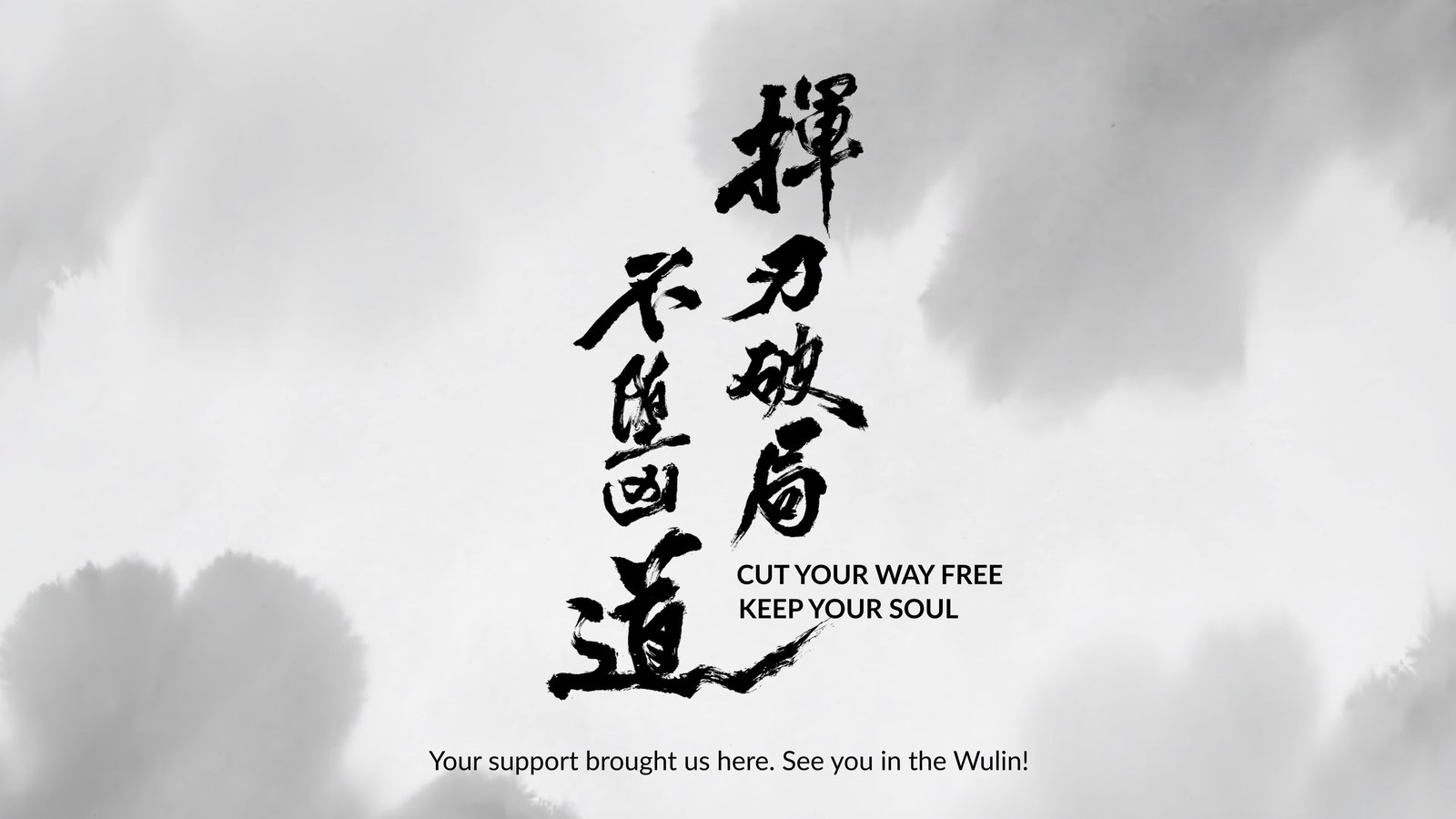
Plate IIThe launch trailer's last card. Official Launch Trailer, Oct 2026S-GAME · Official media
About 2006, when he was twenty, Liang wrote the core of Rainblood's story in three lines: a sword is a weapon of killing; the game is desire and scheming; a 侠 breaks the game with the sword and never falls onto the path of killing.
A 2016 magazine profile quotes the lines as the story core he wrote ten years before.
In the launch trailer's Mandarin dub, one line says that to stop the killing you need the strength to beat every enemy. The English line in the same place is 'Restraint means nothing without strength to back it.'
The dub has no subtitles, so the Chinese is my transcription. A speech-to-text pass heard 直杀, which makes no sense in the sentence; 止杀, stop the killing, fits it.
My reading: a Chinese player hears that line against the old reading of the character 武 as 止, stop, and 戈, the dagger-axe. You get strong so that the fighting ends.
Where that reading of 武 comes from, and why dictionaries doubt it, is on the Iron Fever page.
A second Mandarin line says: I want to live too, but everyone has to be able to live. The English line in its place says everyone deserves that chance.
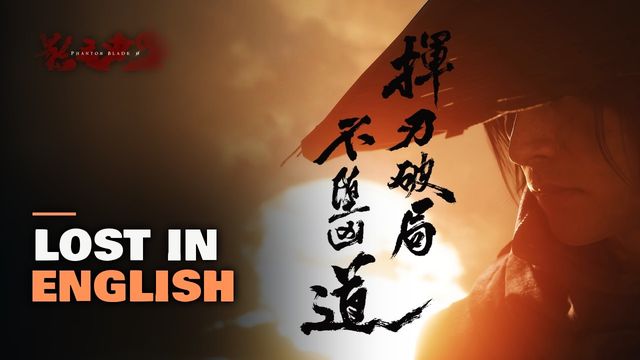
The trailer's last card sets brush calligraphy, 揮刃破局 / 不墮凶道, beside the English CUT YOUR WAY FREE, KEEP YOUR SOUL. My closer rendering is: swing the blade and break the rigged game; never fall onto the murderous path.
破局 is breaking out of a set position, and 'rigged' is my reading of it. 凶道 is a murderous path, and 墮 is to fall. S-GAME's post with its Chinese upload opens with the same eight characters.
To me the trailer opens on the ones who fell and closes on a vow not to fall. Its first line praises a man for holding back the Maskwalkers, and the card's 墮 is the fall S-GAME's 2023 world text gives the fighters who became the 怪面.
Reading the Maskwalkers as the 怪面 is mine, from the Mandarin and English lines in the same place.
Within half an hour of the trailer going up, Liang's comment under S-GAME's Chinese upload went to the top. It hasn't been an easy road, he wrote, but swing the blade, break the game, never fall onto the murderous path is the eternal theme, and it has never changed.
The One Year Ago card's English says the Order joins forces with the Mandate, and the Chinese on the same frame says the masters of the righteous path.
Wuxia is grounded in the human world with few supernatural elements, and xianxia is about immortals, with riding a flying sword among its signature images.
Every fact on the culture pages carries one of these. The fourth is for what I read off my own save. English in brackets after a Chinese quote is my own rendering.
ConfirmedS-GAME's own words, or a reference I opened and quote: the original text, a dictionary, an encyclopedia, a study or a news report.
ReportedSomeone else says it: a Chinese player, an uploader, a guide or a critic, named every time.
TheoryMy own reading of the material, labelled as mine and never presented as fact.
My saveRead off my own PS5 Pro save: the game's text, its voice lines and what happens in a fight, dated, with a link to the moment in the film.